
Movement Hub
on Harmful Information
A platform for and by the Red Cross and Red Crescent Movement to collectively detect, assess, and cope with harmful information, while strengthening capacities and advancing solutions to protect humanitarian action.
What is Harmful Information?
Harmful information is any information, shared online or offline, that has the potential to cause harm. It is an umbrella term that includes:
- Misinformation (false information shared without intent to deceive)
- Disinformation (false information deliberately created or shared to deceive)
- Malinformation (genuine information used maliciously to cause harm)
- Hate speech
- Information that violates international humanitarian law (IHL) or international human rights law.
Why does it matter?
When harmful information spreads during armed conflicts, disasters and other crises, its consequences can be immediate and life-changing. It can:
- Reduce people's access to life-saving information and humanitarian assistance.
- Increase exposure to violence, discrimination and stigma.
- Undermine trust in humanitarian organizations and the communities they serve.
- Fuel fear, polarization and hostility.
- Distort understanding of Fundamental Principles and international law.
Why is this important for the Movement?
The International Red Cross and Red Crescent Movement (the Movement) operates where reliable information can save lives. Harmful information can undermine humanitarian action by reducing trust and acceptance, affecting access to communities, disrupting operations, and increasing risks for staff and volunteers. Ultimately, it can prevent people affected by crises from receiving the protection, assistance and services they need.
As harmful information continues to evolve across digital and physical spaces, strengthening the Movement's ability to understand, anticipate and respond to these risks has become an operational necessity. With this Hub, the Movement seeks to focus on the humanitarian consequences of harmful information, ultimately preserving the space for principled humanitarian action.
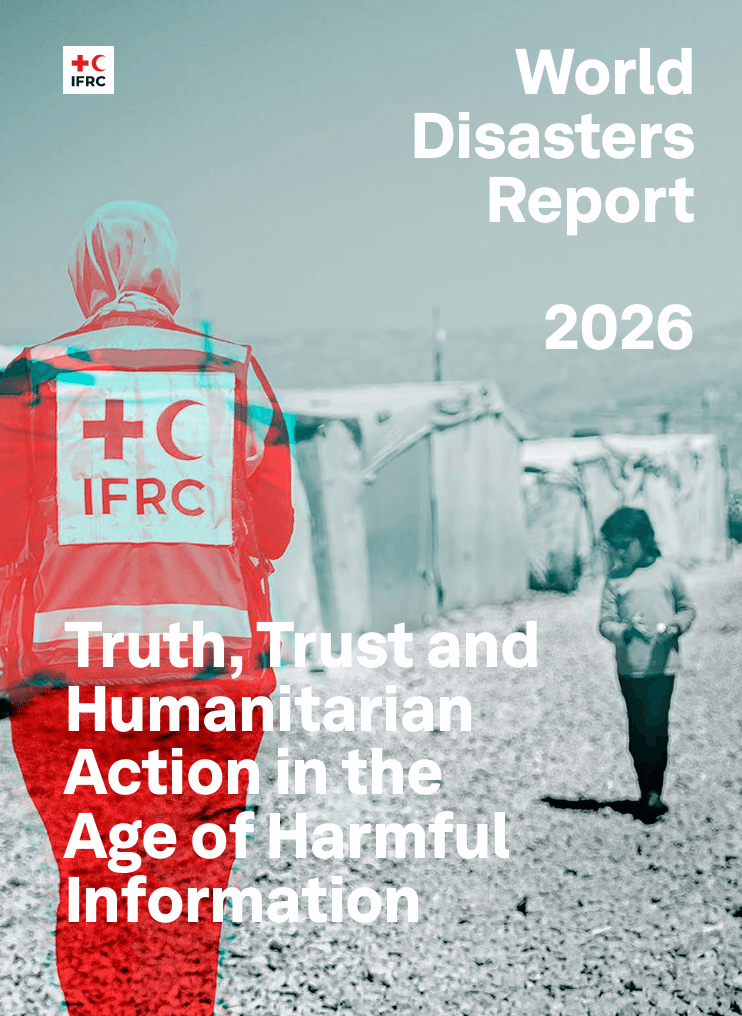
IFRC's World Disasters Report 2026
Truth, Trust and Humanitarian Action in the Age of Harmful Information
The World Disasters Report 2026 identifies harmful information as a de facto humanitarian crisis, undermining access to aid, eroding trust, and putting communities and humanitarian actors at risk. No longer a peripheral issue, it is a core operational challenge. Drawing on global insights, the Report highlights its impacts and offers practical pathways to strengthen resilience, safeguard principles, and rebuild trust.
The Challenge
The spread of harmful information has become a critical challenge for the Movement. Harmful information takes many different forms and appears across multiple platforms and contexts.
This type of information undermines public understanding of humanitarian principles and creates confusion about the Movement’s role and mandate. It erodes trust in the Movement, weakening the credibility that is essential for its work. Furthermore, it jeopardizes the Movement’s acceptance and ability to carry out its principled humanitarian work in sensitive and often high-risk settings.
As a result, it puts its staff and volunteers, as well as vulnerable populations, at increased risk. This increased risk can affect both the safety of individuals and the effectiveness of humanitarian operations, further compounding the challenges faced by the Movement.
Movement Hub on Harmful Information
A platform for and by the Movement to collectively detect, assess, and cope with harmful information, while strengthening capacities and advancing solutions to protect humanitarian action.
Hub Structure
- Steering Committee: Swiss Red Cross, International Federation of Red Cross and Red Crescent Societies, International Committee of the Red Cross, Botswana Red Cross Society, Costa Rican Red Cross, Red Crescent Society of Kyrgyzstan, Qatar Red Crescent Society, and Singapore Red Cross Society
- Permanent Secretariat: Philippe Stoll (Manager), Janine Michel (Communication Advisor)
- Coordination Group: not yet constituted
Our Workstreams
To best serve the Movement, the Hub will focus on four areas that are distinct but complementary. These areas were defined based on the needs expressed by National Societies during consultations in 2024 and were validated by a group of Movement leaders at the end of 2024. The coordination group will ensure that each workstream aligns with and complements the others. It will focus on the effective allocation of resources and on avoiding duplication.
Workstream 1
Crisis Management
Establish a coordination mechanism enabling timely, collective responses through early detection, shared analysis, and aligned communication and operational approaches.
Workstream 2
Training
Strengthen capacities at all levels — volunteers, staff, experts, and leadership — through a multidisciplinary 360° approach across communications, programmes, policy, and HR.
Workstream 3
Thematics
Strengthen coherence by linking the initiative with other Movement frameworks like MHPSS, Safer Access Framework, Community Engagement, and the Fundamental Principles.
Workstream 4
External Engagement
Contribute to the global body of knowledge on harmful information, support humanitarian diplomacy, and bring together professionals, researchers, and stakeholders.
How to participate
There are different options to become part of the Hub. Depending on your background or affiliation with the Movement.
Members of the Movement
The Harmful Information Hub is a collaborative platform for National Societies, the IFRC and the ICRC to strengthen the Movement's collective preparedness and response to harmful information.
Whether you have operational experience, technical expertise, research capacity or simply a challenge you'd like to solve together, there are many ways to contribute.
Shape the Movement's work
- Join a Workstream and help develop practical guidance, tools and recommendations (approximately 4–5 hours/month).
- Contribute to the 2026 Council of Delegates Resolution
- Co-design new initiatives by sharing ideas, identifying priorities and helping shape the Hub's future work.
Share your expertise
- Share tools, methodologies and good practices that have worked in your context.
- Bring operational case studies and lessons learned to strengthen the Movement's collective knowledge base.
- Lead or contribute to collaborative research with the Hub and academic partners.
Strengthen the Movement
- Report emerging harmful information trends affecting your National Society or operational context.
- Co-host events, workshops or webinars.
- Request or provide technical advice or peer support on preparedness, monitoring, crisis response or communications..
- Participate in Hub trainings and learning activities.
External to the Movement
If you have expertise in the field of harmful information, we would welcome the opportunity to connect with you. You can get involved as a:
- Research partner
- Resource expert
- Ambassador for the initiative
- Guest lecturer
We invite you to share your knowledge and contribute to our work.
Work with us
Would you like to participate or invite the Hub as a speaker? In either case, please send us a message.
Resources
- «Addressing Harmful Information in Conflict Settings: A Response Framework for Humanitarian Organizations» | ICRC (icrc.org)
- «World Disasters Report 2026» | IFRC (ifrc.org)
- «How harmful information on social media impacts people affected by armed conflict: A typology of harms» | International Review of the Red Cross | Cambridge Core (cambridge.org)
- «Call for respect and support for principled humanitarian action» | RESOLUTION CoD 2024 (rcrcconference.org)
- «Protecting civilians and other protected persons and objects against the potential human cost of ICT activities during armed conflict» | RESOLUTION International Conference 2024 (rcrcconference.org)
- «Movement-wide Commitments for Community Engagement and Accountability» | RESOLUTION CoD 2019 (rcrcconference.org)
- «Safeguarding humanitarian data» | RESOLUTION CoD 2022 (rcrcconference.org)
Current development
About us
Steering Committee: Swiss Red Cross, International Federation of Red Cross and Red Crescent Societies, International Committee of the Red Cross, Botswana Red Cross Society, Costa Rican Red Cross, Red Crescent Society of Kyrgyzstan, Qatar Red Crescent Society, and Singapore Red Cross Society
Permanent Secretariat: Philippe Stoll (Manager), Janine Michel (Communication Advisor)
Coordination Group: not yet constituted
What happened so far?
The Movement has already taken steps to address the challenge. It has laid the groundwork for a more cohesive approach and set out practical pathways for action through iterative statutory resolutions, resources developed by National Red Cross and Red Crescent Societies (National Societies) and reports such as Addressing Harmful Information in Conflict Settings by the International Committee of the Red Cross (ICRC) and the / by the International Federation of Red Cross and Red Crescent Societies (IFRC), which draws on case studies from more than 30 Movement partners. However, existing efforts remain fragmented, and there is an urgent need for a Movement-wide effort to ensure responses are consistent, coordinated and contextually appropriate.
2024–2026
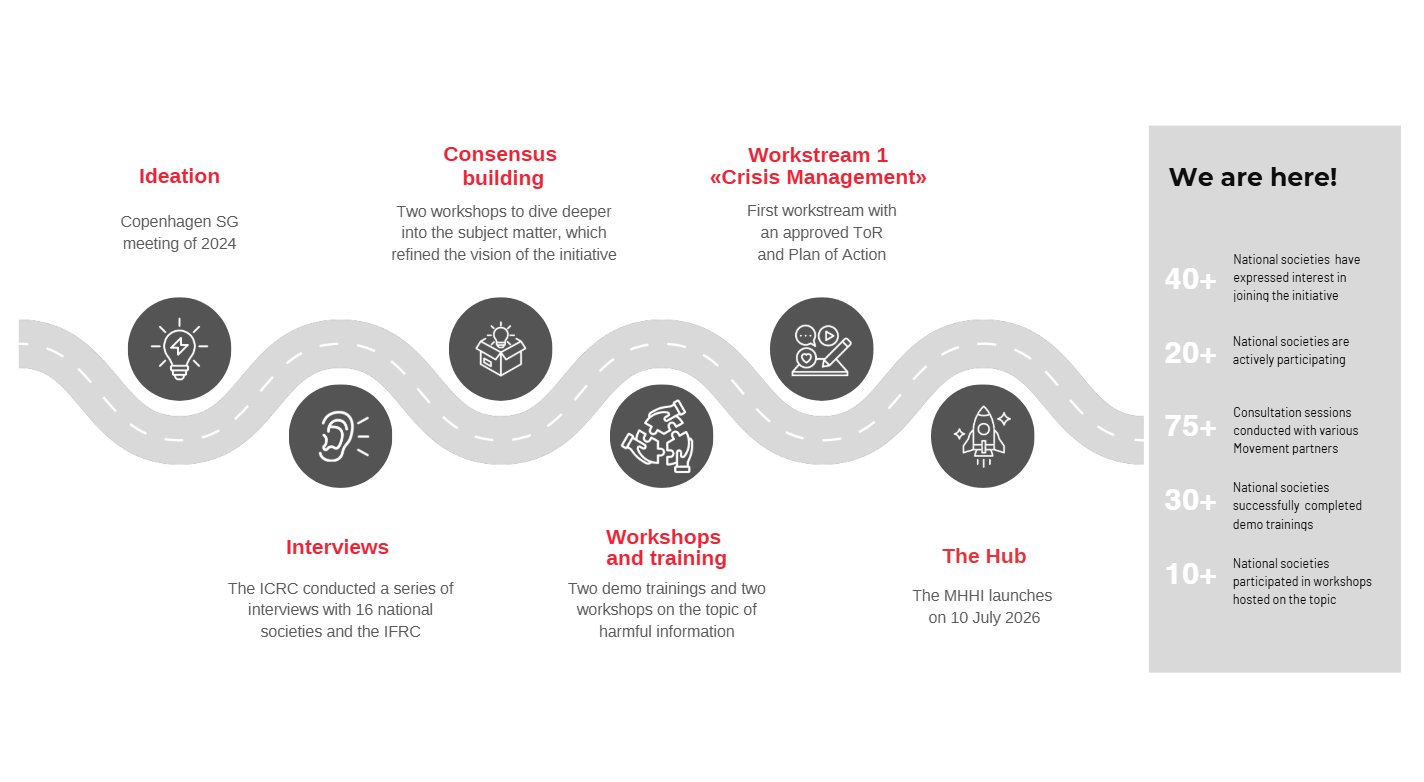
Roadmap from Initiative to Movement Hub on Harmful Information
Join the Movement Hub
Share your cases, contribute material, and collaborate with Movement partners worldwide through our workstreams.